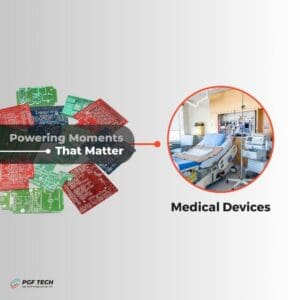
 When a loved one is in the hospital, the focus should be on the patient. That’s why countless systems work quietly in the background raising hospital beds, tracking vital signs, and even guiding robotic surgical procedures, to heal the patient and keep them comfortable.
Each of these machines must work at top quality continuously to keep your attention where it matters most. So, what allows this equipment to work consistently at the highest caliber?
Behind nearly every one of these machines is a small but critical powerhouse: a Printed Circuit Board Assembly (PCBA). In a medical environment where accuracy, reliability, and consistency are non-negotiable, PCBAs are meticulously assembled to meet the demands of clinical use and help keep patients safe. These boards may be hidden, but their impact is felt in every interaction between technology and patient care.

PCBA Applications in the Medical Space
Hospitals rely on an ecosystem of devices, many of which operate under strict performance requirements. PCBAs serve as the foundation for the ecosystem, enabling communication, control, and data accuracy across a wide range of applications. Large hospitals can include up to 50,000 PCBAs in their facilities, so it is critical that each is working smoothly.
In patient monitoring systems, PCBAs process and transmit real-time data such as heart rate, oxygen levels, and blood pressure. These readings guide clinical decisions and alert staff when intervention is needed. Accuracy and signal integrity are critical as small inconsistencies can have significant impacts on the patients’ health.
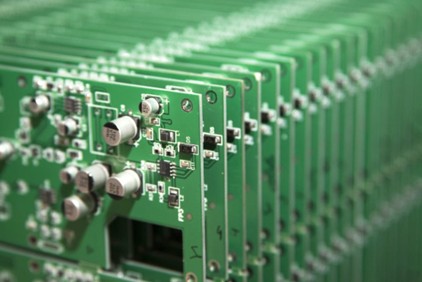
PCBAs are also integral to infusion pumps, ventilators, and other life-support equipment. In this type of machinery, precise control and repeatable performance are required around the clock, making durability and long-term reliability the highest priority.
In imaging and diagnostic equipment, PCBAs help manage complex data acquisition and processing, enabling clinicians to see, measure, and diagnose with confidence. Surgical robotics and minimally invasive tools rely on PCBAs to translate precise inputs into controlled, repeatable movements where milliseconds and microns matter.
Across the hospital floor, PCBAs quietly ensure that systems work together seamlessly to support care teams.
Quality and Testing Are Non-Negotiable
In medical device manufacturing, quality is not something that can be inspected at the end; it must be built into every step of the PCBA assembly process.
Testing of PCBAs occurs throughout production. At PGF Tech, testing processes are designed to fit industry standards, customer-specific needs, and PGF quality guidelines. Although each testing process may be unique, they all follow the general testing procedures below.
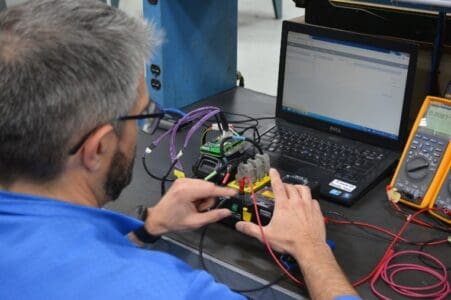
After SMT and soldering processes, each component on the PCBA is inspected manually to ensure proper placement. Then, each individual part of the PCBA is tested for functionality. Each stage is designed to catch potential issues early, when they can be addressed without introducing additional risk. This layered approach ensures that performance, reliability, and consistency are maintained from board to board.
Final testing serves as confirmation that every step of the assembly process has been completed correctly. It is a way to double-check the work, verifying that the board will perform as expected in real-world medical environments where tolerance for error is extremely low.
Maintaining an ISO 13485 certification plays a critical role in this process. It establishes a quality management framework specifically designed for medical devices, emphasizing traceability, documentation, and process control. For PCBAs, this means every decision, material, and test result is accounted for, supporting both regulatory compliance and patient safety.
PCBAs may be small, but in medical device manufacturing, their role is critical to adjust hospital beds smoothly, deliver accurate vitals on the monitors, complete surgeries with precision, and much more. These boards support life-saving equipment and help care teams focus on what matters most: the patient.
If your medical devices depend on reliable electronics, working with an experienced PCBA partner like PGF Tech can make all the difference. Learn how precision assembly, rigorous testing, and a commitment to quality help ensure performance where it matters most by contacting us here: Contact Us | PGF Technology Group